

20 March 2026
Element-Arval 2026 Barometer report: Australia and New Zealand insights
The 2026 Fleet and Mobility Barometer marks a shift from ambition to execution.
Globally, organisations are moving from expansion to optimisation. Electrification remains a priority, but progress is increasingly shaped by infrastructure readiness, cost pressures and regulatory complexity.
Across Australia and New Zealand, confidence remains strong. What differs is how fleets are being optimised in practice.
Australia: confidence remains, execution is measured
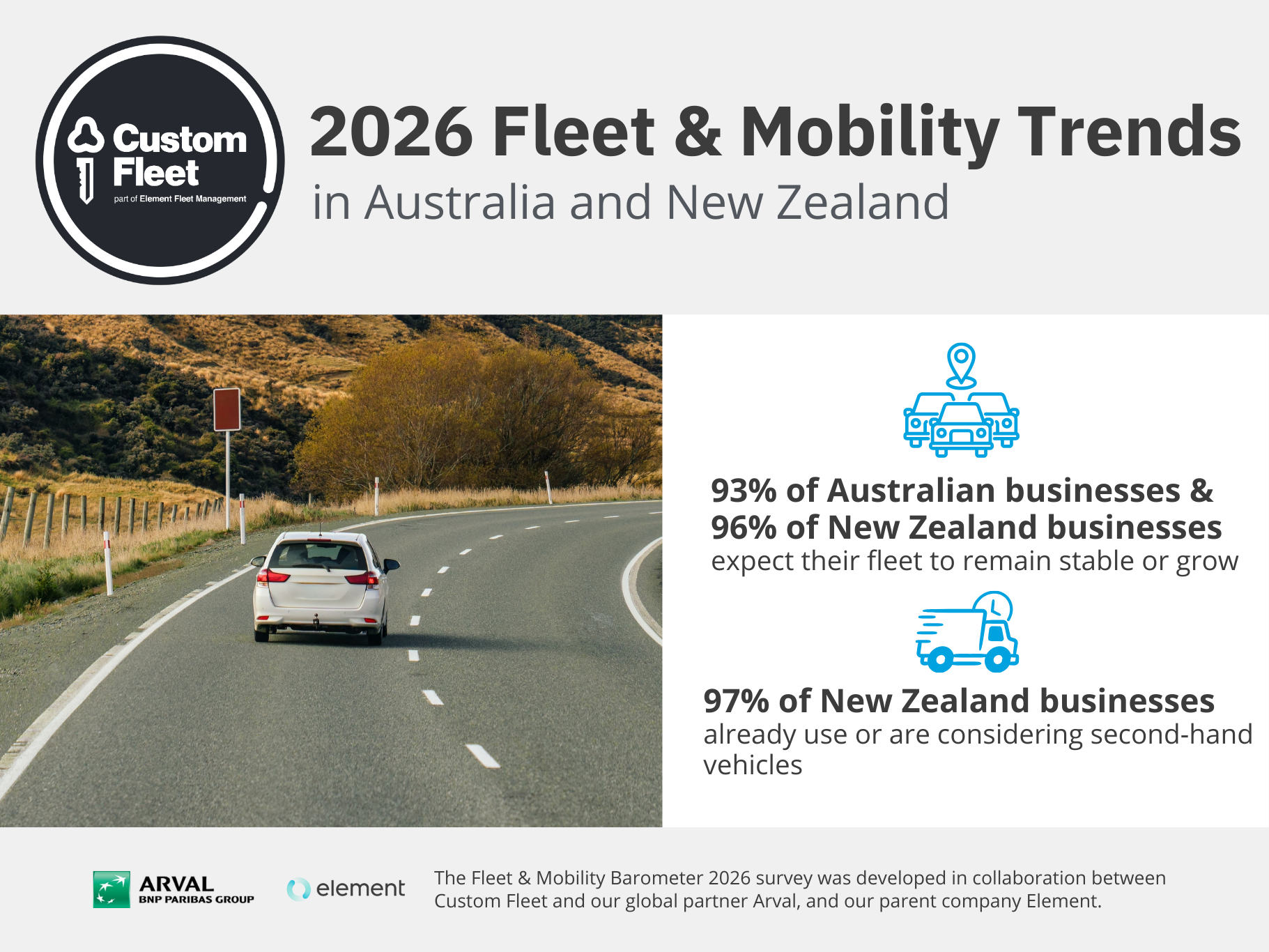
Australian organisations continue to show strong confidence in fleet stability over the medium term. In 2026, 93% expect their fleet to remain stable or grow over the next three years, with 24% expecting growth.
Electrification is established, but the next stage is shaped by infrastructure readiness.
In 2026, 52% of organisations already operate electrified passenger vehicles, including hybrid, plug-in hybrid and battery electric vehicles. Charging infrastructure remains the primary constraint, cited by 61% of businesses.
Despite this, planning is well underway. 86% of Australian fleets have implemented or are developing workplace charging strategies.
Second-hand vehicles are emerging as a practical optimisation lever.
In 2026, 28% of organisations include second-hand vehicles in their fleets, up from 25% in 2025, with a further 55% considering adoption. This reflects a steady shift toward cost and supply flexibility rather than a rapid market change.
Financing remains largely ownership-led, but larger organisations are adopting more flexible structures.
Only 10% cite full-service (operational) leasing as their primary financing method, rising to 20% among large organisations, compared with small (7%) and medium sized companies (10%). Looking ahead, 21% plan to increase or introduce their use of full-service leasing, indicating targeted growth where scale supports it.
Overall, Australia’s 2026 outlook reflects stable confidence, with a gradual move toward execution. Electrification continues, while second-hand vehicles and selective leasing support cost control and operational efficiency.
New Zealand: strong confidence, with clear execution signals
New Zealand organisations remain highly confident, with 96% expecting fleet size to remain stable or grow and 27% anticipating growth.
Second-hand vehicles are now a mainstream strategy.
In 2026, 52% of organisations already include second-hand vehicles, with a further 45% considering adoption. This brings total engagement to 97%, up from 90% in 2025. It's one of the clearest indicators of execution at scale.
In 2026, 52% of organisations already include second hand vehicles and 45% are considering them. That is 97% using or considering second hand vehicles, up from 90% in 2025.
This is one of the clearest execution signals in the New Zealand results: fleets are actively adopting optimisation approaches at scale.
Electrification is more advanced and should be read with the correct definition.
New Zealand’s electrification results refer to electrified passenger vehicles, which includes hybrid (HEV), plug in hybrid (PHEV) and battery electric vehicles (BEV). This indicates electrification remains a major pillar alongside second hand adoption and financing shifts.
Fleet structure is stable, with a small shift in distribution across years. In 2026, New Zealand fleets are composed of:
- 6% with 1–9 vehicles
- 53% with 10–99 vehicles
- 41% with 100–999 vehicles
The same chart shows the smallest bracket is lower than prior years (9% in 2024/2025 to 6% in 2026) and the 100–999 bracket is higher (38% in 2024/2025 to 41% in 2026), suggesting a modest shift in the sample toward larger fleets.
Financing flexibility remains a notable theme.
New Zealand’s executive summary notes 18% cite full service leasing as the main financing method, with 22% planning to introduce or increase full service leasing, indicating steady growth potential.
Overall, New Zealand’s 2026 story demonstrates stronger execution. Second-hand vehicles are embedded, electrification continues under a broader definition that includes HEV/PHEV, and financing models are evolving to support optimisation.
One region, two execution paths
Across ANZ, confidence remains high, but execution differs.
Australia shows steady progress with gradual adoption of optimisation levers such as second hand vehicles and segment led leasing uptake. New Zealand shows faster execution, with second-hand vehicles widely adopted and financing structures evolving more quickly.
Together, these insights reinforce the 2026 theme: success is no longer defined by ambition alone, but by the ability to execute in real operating conditions.
Downloads
- Australian 2026 Barometer report [14.1MB, PDF]
- New Zealand 2026 Barometer report [14.4MB, PDF]
- To download the full report, the Global 2026 Barometer report [17.4MB, PDF]